
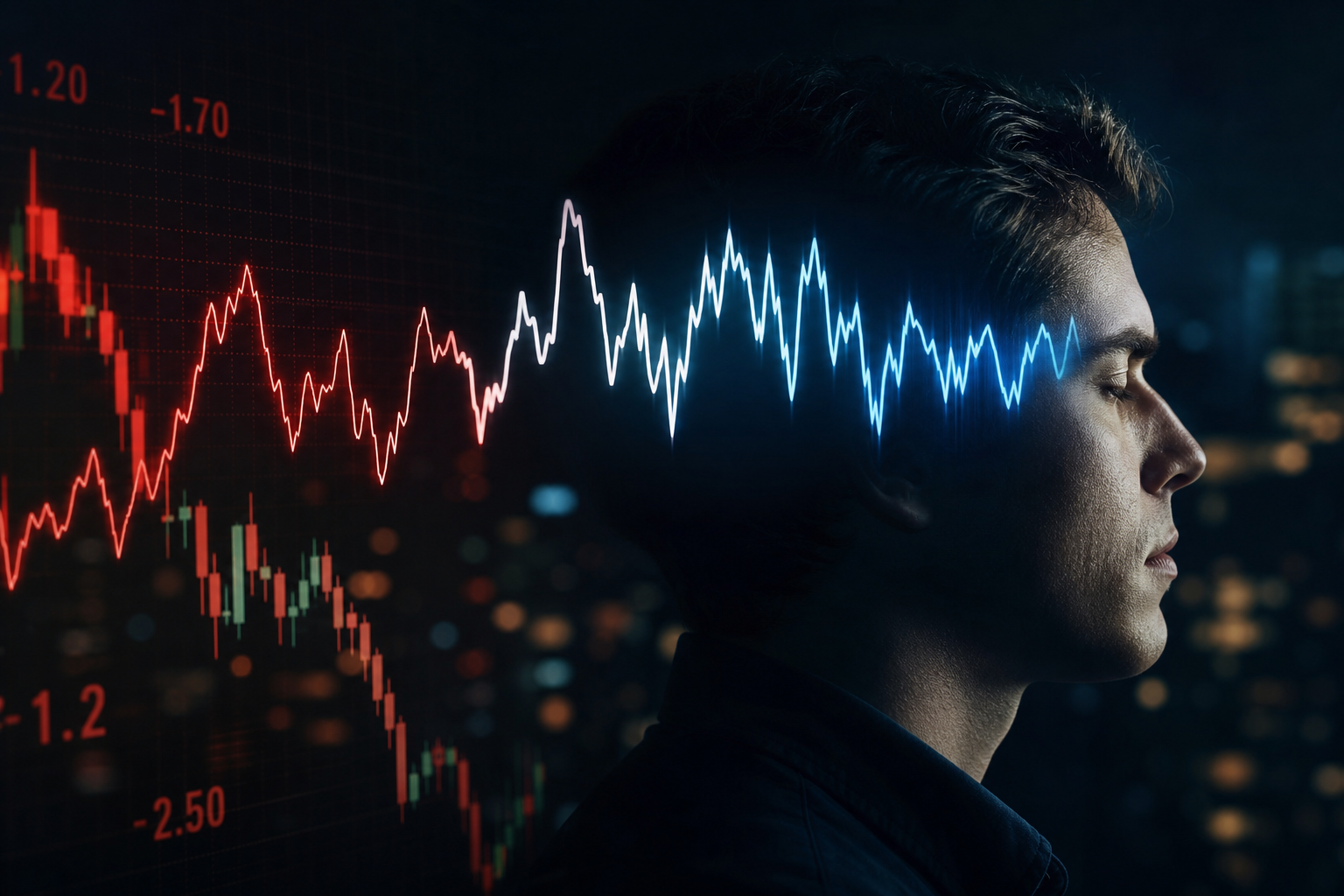
The Market Is Not a Machine, It Is a Crowd
In the quiet of a pre-market morning, Wall Street can feel like a machine of pure logic—a vast engine of capital allocation running on data, earnings, and discounted cash flows. Then the opening bell rings, and the illusion shatters. A headline hits, an estimate is missed, and suddenly the machine reveals itself for what it truly is: a crowd. And crowds are driven by something far older and more powerful than any algorithm: human psychology.
Market volatility is often discussed in terms of macroeconomic indicators or monetary policy shifts. But the true engine of sharp, seemingly irrational market swings is found in the predictable biases of the human mind. The field of behavioral finance has spent decades mapping these cognitive shortcuts and emotional traps. For any serious investor, understanding this internal wiring is as critical as reading a balance sheet. It is the operating system on which the market runs.
The Asymmetric Pain of a Loss
At the core of much market panic is a concept known as loss aversion. Pioneered by psychologists Daniel Kahneman and Amos Tversky, it describes a simple but profound truth: the psychological pain of losing a dollar is roughly twice as powerful as the pleasure of gaining one. This asymmetry hardwires investors to make poor decisions under pressure.
When a portfolio is deep in the red, loss aversion triggers a visceral, fight-or-flight response. The logical move might be to re-evaluate the initial investment thesis, but the emotional imperative is simply to “make the pain stop.” This is what fuels capitulation selling at market bottoms, where investors liquidate holdings not for strategic reasons, but for psychological relief. Conversely, it explains why many will cling to a losing position, hoping it will return to breakeven—a point of no emotional loss—even as fundamentals deteriorate.
The Perceived Safety of Herding
Finance is a discipline of independent thought, yet Wall Street is a landscape of consensus. This paradox is explained by herding behavior, the tendency to follow the actions of a larger group. In an environment of uncertainty, the brain defaults to a simple heuristic: if everyone else is running for the exit, they must know something I don’t.
Herding amplifies market trends in both directions. It inflates bubbles, as the fear of missing out (FOMO) compels capital to chase assets with soaring prices but detached fundamentals. We saw this in the dot-com era and again in more recent speculative frenzies. The same mechanism works in reverse during a crash. As a selloff gathers momentum, the pressure to join the herd and sell becomes immense, creating a self-reinforcing downward spiral. The crowd offers the illusion of safety, but it often leads directly off a cliff.
The Echo Chamber of Conviction
Once an investor has a thesis—that a company is destined for greatness or a market is headed for a downturn—a third bias takes hold: confirmation bias. This is the mind’s tendency to seek out, interpret, and favor information that confirms what it already believes, while dismissing evidence to the contrary.
In the digital age, this is easier than ever. An investor bullish on a particular technology stock can curate a feed of optimistic analyst reports and glowing press, filtering out warnings about competition or valuation. This creates an intellectual echo chamber that reinforces conviction, making the investor less able to adapt when the narrative changes. It turns a working hypothesis into an article of faith, and in markets, faith is a notoriously poor risk manager.
Discipline as the Antidote
These biases are not a sign of intellectual failure; they are features of human cognition. The most disciplined players on Wall Street are not those who lack these emotions, but those who have built systems to neutralize them. They operate not on gut feeling but on process—an investment mandate, a pre-defined strategy for entering and exiting positions, and a rigorous analytical framework that is tested before market turmoil begins, not during.
The market will always be a reflection of our collective hopes and fears. Volatility is the price of admission. The enduring challenge for any investor is not to predict the crowd, but to avoid becoming lost in it. The most important risk to manage is not the one on the screen, but the one in the mirror.
This article is for informational and educational purposes only and should not be considered investment advice. All investment strategies involve risk, including the possible loss of principal.
