
The Central Question on Wall Street: Beat the Market, or Own It?
In the ecosystem of modern finance, few debates are as fundamental or persistent as the one between active and passive investing. It is more than a technical dispute over strategy; it is a philosophical divide on the very nature of markets. On one side are the active managers—the stock pickers and bond traders who believe that through skill, research, and intuition, they can outperform the market averages. On the other are the proponents of passive investing, who argue that trying to beat the market is a costly, losing game and that the wisest course is to simply buy the market itself through low-cost index funds.
To the serious investor, this is not an academic exercise. The choice between these two approaches has profound implications for long-term wealth creation. Understanding the arguments, and more importantly the evidence, is crucial to building a coherent investment framework.
The Unforgiving Arithmetic of Passive's Appeal
The case for passive investing begins not with a grand theory, but with simple, powerful arithmetic. At its core are two factors: costs and the zero-sum nature of the market.
Passive vehicles, like index funds and exchange-traded funds (ETFs), aim to replicate a market benchmark, such as the S&P 500. By eliminating the need for a team of highly paid analysts and frequent trading, their operating costs—measured by the expense ratio—are exceptionally low. In contrast, active funds employ managers and research teams to select specific securities, incurring higher trading costs and management fees.
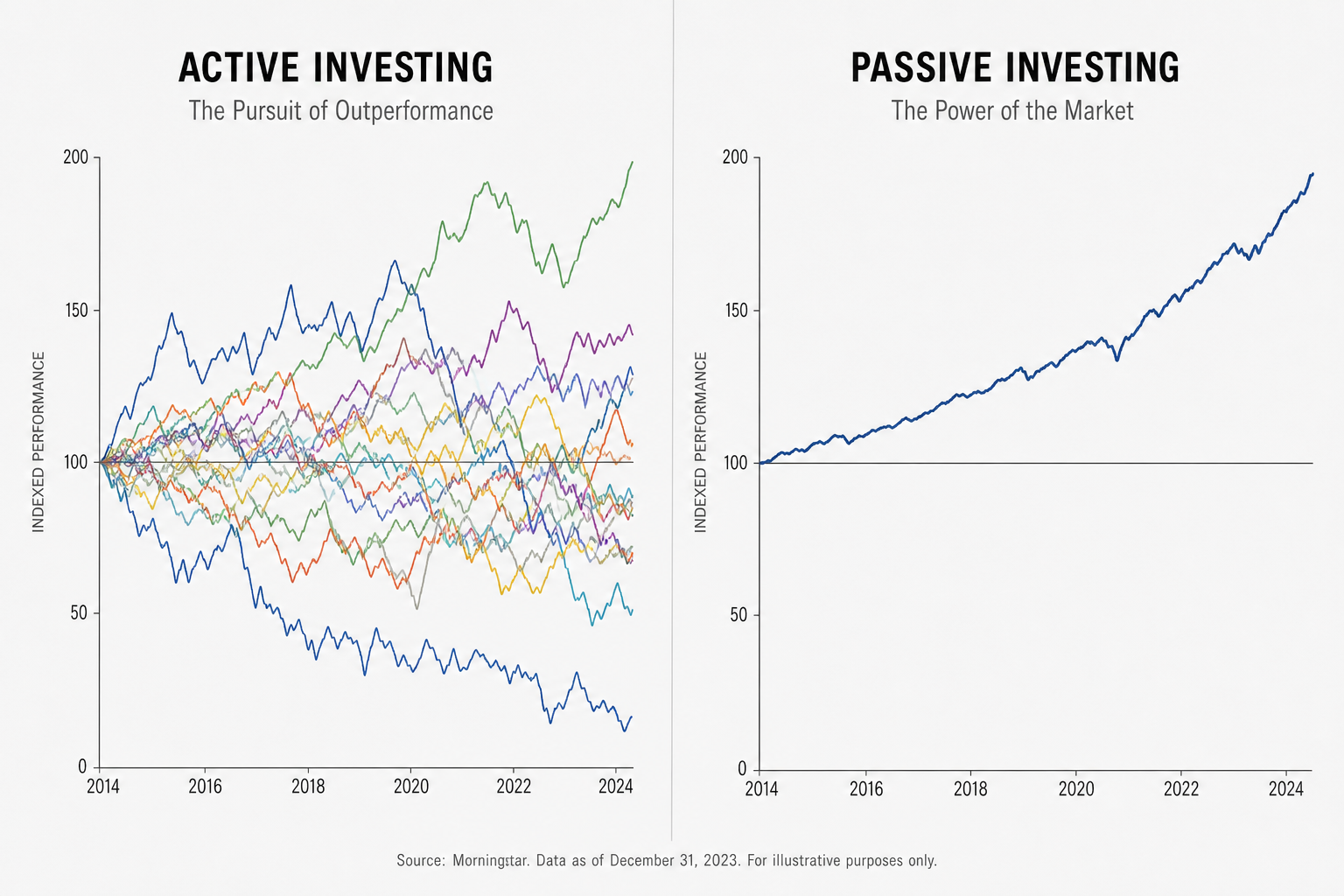
The critical insight, first articulated by Nobel laureate William F. Sharpe, is that the market is a zero-sum game before costs. For every active investor who beats the market average, another must underperform it by the same amount. The aggregate of all active portfolios is, by definition, the market itself. Once you introduce the higher fees charged by active managers, the mathematical conclusion is inescapable: the average active investor must underperform the average passive investor.
The data bears this out with stark consistency. The S&P Indices Versus Active (SPIVA) Scorecard, a widely cited industry report, repeatedly shows that a large majority of active fund managers fail to beat their benchmarks over time. For instance, over a recent 10-year period, more than 85% of U.S. large-cap fund managers underperformed the S&P 500 [VERIFY]. As the time horizon extends to 15 or 20 years, the figures for active managers become even more grim.
In Defense of Skill: Where Active Management Fights Back
If the data is so conclusive, why does the multi-trillion-dollar active management industry continue to thrive? The defense of active management rests on the idea that while the average manager may fail, skilled managers can and do succeed. The goal, they argue, is not to hire the average manager, but an exceptional one.
Proponents point to several key areas where active management may still hold an edge:
- Inefficient Markets: The argument for passive investing is strongest in highly efficient, heavily researched markets like U.S. large-cap stocks, where information is disseminated almost instantly. In less efficient corners of the market—such as emerging markets, small-cap stocks, or certain segments of the bond market—skilled managers argue they can exploit information gaps to generate alpha, or returns above the benchmark.
- Risk Management: An index fund is contractually obligated to remain fully invested in its target index, for better or worse. In a sharp market downturn, it will ride the index all the way down. An active manager, however, has the flexibility to move into defensive positions, build up cash reserves, or use hedging strategies to mitigate losses. This potential for downside protection is a key selling point.
- Concentrated Conviction: An index fund owns hundreds, sometimes thousands, of stocks, including the mediocre and the failing. An active manager can build a concentrated portfolio of their highest-conviction ideas, seeking to generate outsized returns by betting heavily on a smaller number of perceived winners.
The Verdict: A Question of Probability, Not Possibility
The debate between active and passive investing is not about possibility. It is certainly possible for a talented manager to beat the market. The real question is one of probability. What are the odds of an investor selecting one of those winning managers in advance, and what is the cost of trying?
For many investors, the evidence points toward a core portfolio built on low-cost, diversified passive funds. This approach harnesses the power of the market itself while minimizing the drag of fees that can erode returns over decades. It is a strategy of discipline and humility—an admission that consistently outsmarting the collective wisdom of millions of global market participants is a monumental challenge.
Active management, then, becomes a conscious and deliberate decision to deviate from the market, often in specific areas where skill might have a greater chance of making a difference. It is a bet on a manager's talent that must be high enough to overcome the stiff headwinds of higher fees. The choice is not necessarily one or the other, but a matter of how an investor weighs the near-certainty of costs against the uncertain potential for outperformance.
Disclaimer: This article is for informational and educational purposes only and should not be construed as investment, tax, or legal advice. All investing involves risk, including the possible loss of principal. The author is a journalist and does not provide personalized financial recommendations.
