
Signal, Noise, and Capital Allocation
In my years of allocating capital, I have learned a critical discipline: distinguishing between an indicator that merits attention and noise that demands to be ignored. The financial media is a torrent of noise—daily predictions, breathless commentary, and endless speculation. A true indicator, by contrast, is a data point with a structural basis and a historical track record. It does not tell you what will happen tomorrow, but it does offer valuable context about the present.
The U.S. Treasury yield curve is one such indicator. It has earned its reputation as a leading signal for economic shifts. But like any signal, its message can be distorted, and its utility is destroyed the moment it is treated as prophecy. For the serious investor, understanding the yield curve is not about market timing; it is about developing a more complete picture of the economic landscape in which our assets must perform.
The Logic of a Normal Yield Curve
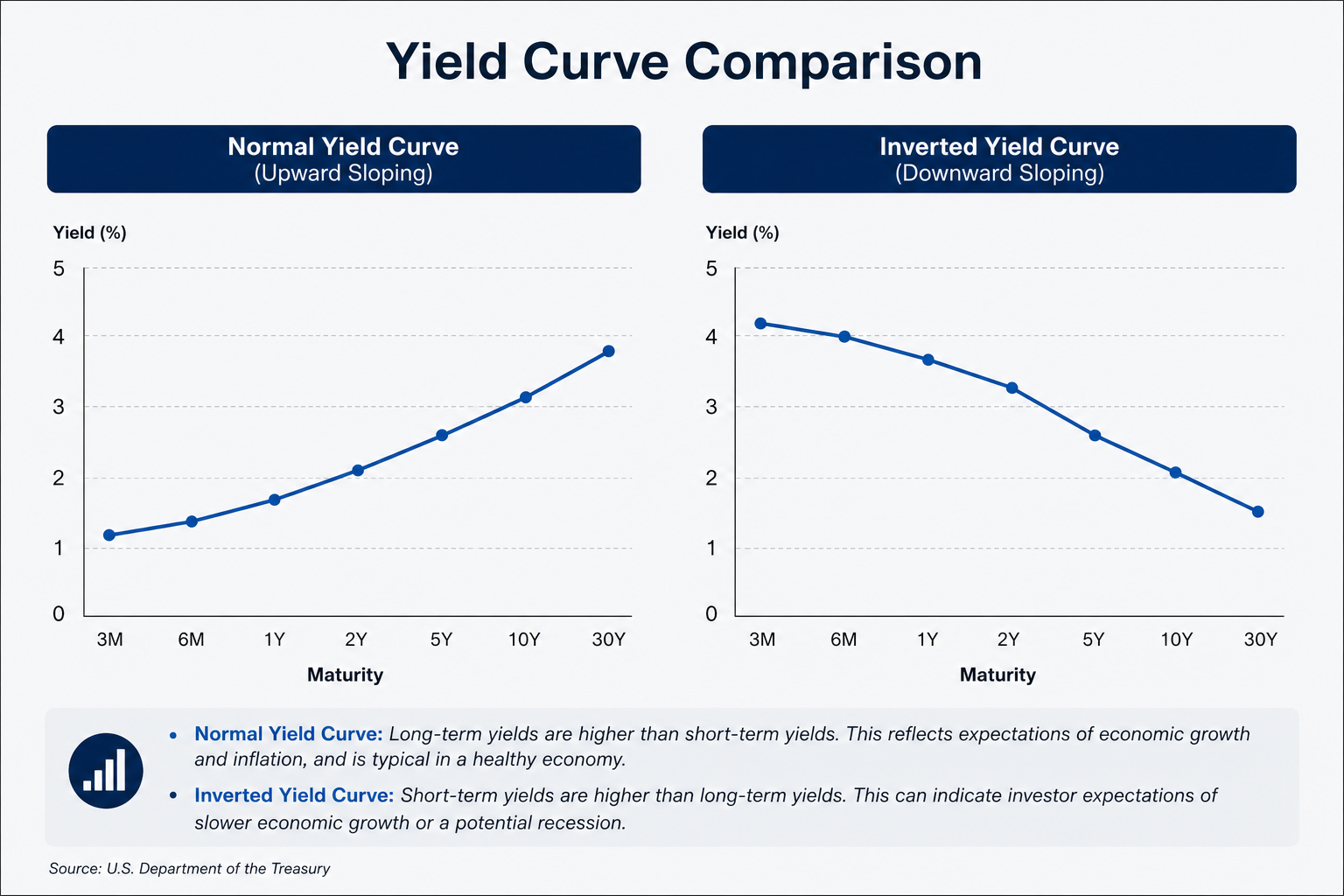
At its core, the yield curve is a simple concept. It is a graphical representation of the interest rates, or yields, on U.S. Treasury debt for a range of different maturities—from one month to 30 years. In a healthy, expanding economy, the curve slopes upward. An investor lending money to the U.S. government for 10 years will, quite logically, demand a higher annual return than one lending for only three months.
This upward slope reflects two fundamental realities:
- Term Premium: Lenders require additional compensation for locking up their capital for a longer period, exposing them to greater uncertainty and inflation risk over time.
- Economic Expectations: A normal curve reflects a collective belief that the economy will continue to grow, which typically brings with it moderate inflation and a monetary policy stance that is either stable or gradually tightening. Lenders expect future rates to be higher, or at least not significantly lower, than current rates.
The normal yield curve represents a state of equilibrium. It is the financial market’s baseline expectation for a functioning economy.
When the Signal Flashes: The Inverted Curve
An inversion occurs when this logic is turned on its head—when short-term Treasury yields rise above long-term yields. An investor might earn a higher return lending to the government for two years than for ten. This is an unnatural state of affairs, and it signals a profound shift in market expectations.
Historically, a sustained inversion of the yield curve, particularly the spread between the 10-year and 2-year Treasury notes, has been one of the most reliable, if imprecise, predictors of a coming recession. The track record is not perfect, but it is compelling enough that it cannot be dismissed. The inversion suggests that the bond market—often called the “smart money”—is anticipating an economic slowdown so severe that it will compel the Federal Reserve to cut interest rates in the future. Investors are so concerned about the near-term outlook that they are willing to accept lower yields on long-term bonds just to lock in a return through the anticipated downturn.
Furthermore, an inverted curve can become a self-reinforcing mechanism by squeezing bank profitability. Banks borrow short-term (e.g., through deposits) and lend long-term (e.g., through mortgages and business loans). When short-term rates exceed long-term rates, this core business model is compromised, which can lead to a tightening of credit conditions across the economy.
The Limits of Prophecy
While the yield curve’s history as an indicator is significant, a signal is not a guarantee. Relying on it as a singular tool for capital allocation is a profound error. Several factors can complicate its message:
First, the timing is notoriously variable. A recession has historically followed an inversion, but the lag can range from several months to over two years. An investor who sells all their assets at the first sign of inversion would likely miss out on significant gains before any downturn materializes.
Second, the structure of the market is not static. Unprecedented levels of quantitative easing and other central bank interventions following the 2008 financial crisis and the COVID-19 pandemic have had a suppressive effect on long-term yields. This can distort the shape of the curve in ways that may not carry the same meaning as in past cycles. When the largest buyer in the market—the central bank—is not acting on purely economic motives, the purity of the signal is compromised.
A Disciplined Investor's Response
So, what does a disciplined investor do with this information? We observe it. We respect its historical context. We integrate it into our broader thesis on the economy. But we do not allow it to dictate our actions.
My strategy has never been to predict the S&P 500 or time the business cycle. It is to own assets that produce cash because they are tied to the real economy. The rent on a commercial property is paid from a tenant’s operating revenue. The return from a portfolio of merchant receivables is generated by the daily sales of thousands of small businesses. These engines of return are certainly influenced by the macroeconomic environment, but they are not defined by the sentiment of the Treasury market.
The yield curve is a valuable instrument on the dashboard. It is not the steering wheel. A wise operator understands what it is telling them about the conditions outside, but keeps their hands firmly on the wheel and their eyes on the road ahead, focused on the performance of the assets they own directly.
This article is for informational purposes only and should not be considered investment advice. All investment decisions should be made with the guidance of a qualified financial professional.
