
The Market's Most Expensive Words
In my years covering Wall Street, I’ve learned that the most dangerous phrases in finance are rarely found in the dense footnotes of a prospectus. They are delivered in a confident voice over the phone, highlighted in a glossy marketing brochure, or broadcast across social media with viral urgency. They are designed not to inform, but to override the healthy skepticism that is an investor's most vital asset.
The financial markets are a complex mechanism for pricing risk and allocating capital. Yet the tactics used to separate investors from their money are often remarkably simple and painfully timeless. The challenge for any market participant—from the seasoned professional to the retail investor—is to recognize the language of deception before it has a chance to impact a portfolio. This is not about market timing or stock selection; it is about the fundamental due diligence that precedes any sound investment decision.
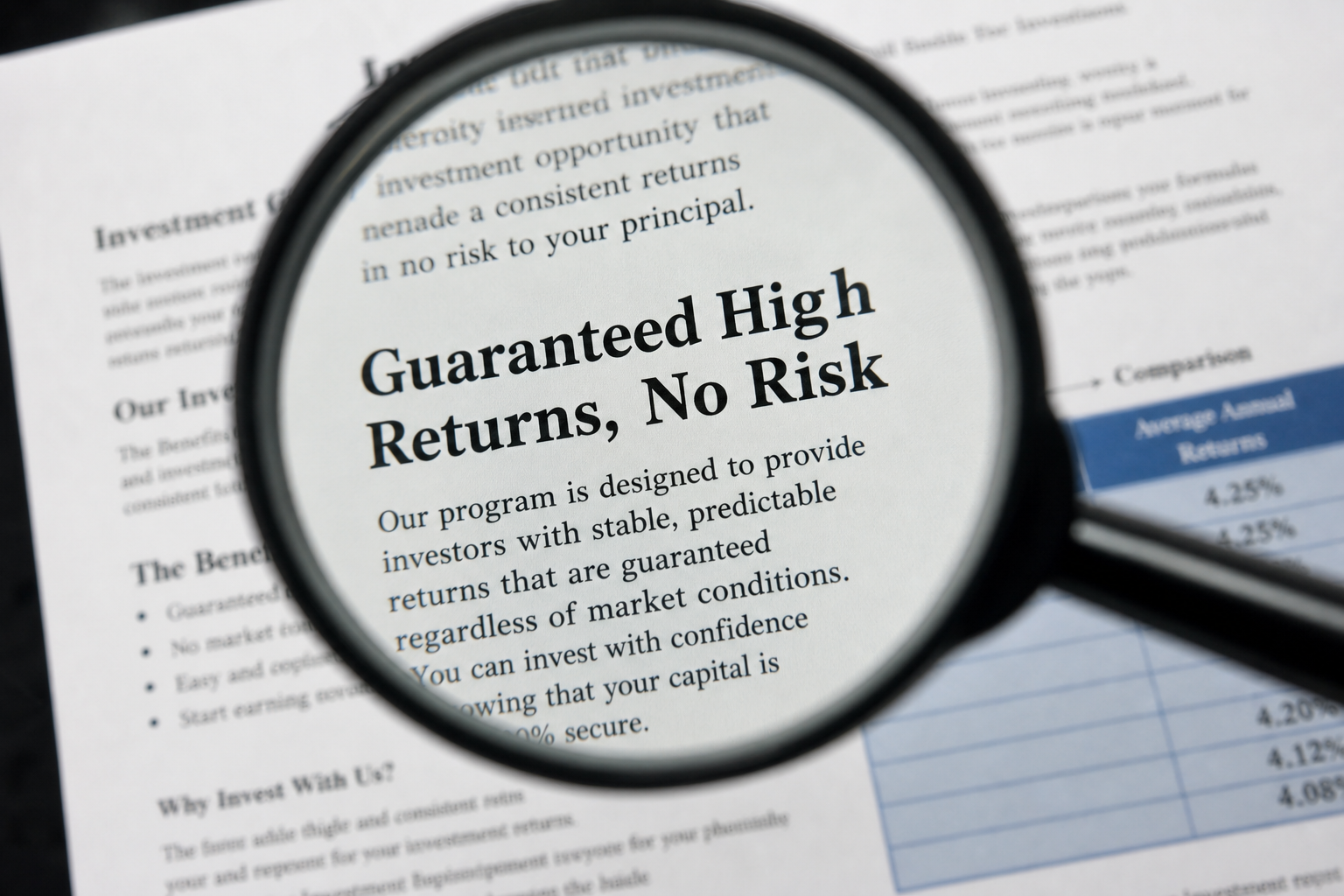
Red Flag 1: The Promise of High Returns with No Risk
The foundational law of capital markets is the relationship between risk and return. To seek higher returns, one must be willing to accept greater risk. Any claim that subverts this principle should be met with immediate and profound skepticism. Phrases to watch for include:
- "Guaranteed returns"
- "A risk-free opportunity"
- "The upside of stocks with the safety of bonds"
Legitimate investments do not offer guarantees. The U.S. government guarantees Treasury bonds, and the FDIC insures bank deposits up to a certain limit. Beyond that, the word "guarantee" in an investment pitch is arguably the brightest red flag in finance. It suggests either a misunderstanding of how markets work or, more likely, a deliberate attempt to mislead.
Red Flag 2: The Pressure of Artificial Urgency
Sound investment theses do not come with an expiration date. Fraudulent schemes, however, often rely on pressuring a target into making a quick decision before they have time for proper analysis or to seek a second opinion. This tactic is designed to provoke a fear of missing out (FOMO) that short-circuits rational thought.
Be wary of any pitch that insists on an immediate commitment. Language like, "This offer is only available today," or "There are only two spots left for founding investors," is the mark of a sales pitch, not a serious investment opportunity. Capital should be deployed based on conviction in the underlying asset, not because of a countdown clock.
Red Flag 3: Complexity as a Cloak
There is a particular type of pitch that weaponizes complexity. It uses layers of jargon, proprietary algorithms, and convoluted structures to intimidate the investor into submission. The implicit message is: "This is too sophisticated for you to understand, but trust us, it works."
This is a classic confidence trick. A legitimate investment adviser or fund manager should be able to explain their strategy in clear, concise terms. If they cannot, or will not, it may be because there is no coherent strategy to explain. If you cannot articulate the investment thesis to someone else, you should not be putting your capital into it. Never mistake complexity for sophistication.
Red Flag 4: The Unverifiable Credential or Track Record
Credibility is often manufactured. A promoter may tout an impressive track record that is hypothetical, back-tested, or simply impossible to verify through an independent third party. They may claim credentials they do not possess or promote an offering that isn't properly registered with regulatory authorities.
Fortunately, regulators provide powerful tools for verification. Investors can and should use FINRA's BrokerCheck and the SEC's Investment Adviser Public Disclosure (IAPD) database to vet any individual or firm offering investment advice or products. A refusal to provide a registration number or a history that doesn't appear in these public databases is a significant warning sign.
An Investor's Best Defense
The enduring lesson from every market cycle is that investor protection begins with the investor. The allure of a story that seems too good to be true is powerful, but the discipline to ask hard questions is more powerful still. The work of safeguarding your capital is not just about analyzing balance sheets and economic data; it's about analyzing the claims and motivations of those who wish to manage it.
In the end, the principles are straightforward: demand clarity, verify credentials, understand the risks, and walk away from any pitch that relies on pressure or promises the impossible. This skeptical framework is the closest thing to a guaranteed return an investor will ever find.
Disclaimer: This article is for informational and educational purposes only and should not be construed as personal investment, financial, legal, or tax advice. The content is not a recommendation to buy or sell any specific security. Always consult with a qualified professional before making any financial decisions.
