
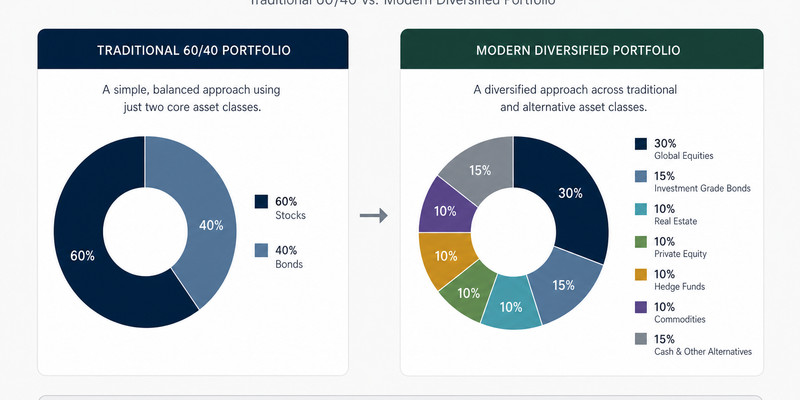
The Foundational Flaw in Today's 60/40 Portfolio
For decades, the 60/40 stock-bond portfolio was the bedrock of conservative wealth management. Its logic was simple and, for a long time, effective: when stocks faltered, high-quality bonds would rally, acting as a ballast. This principle of negative correlation was the portfolio's primary defense mechanism. However, the market environment of the past several years, particularly the inflationary pressures witnessed in 2022, exposed a critical flaw in this model. When rising interest rates punish both equity valuations and bond prices simultaneously, the ballast turns into an anchor.
The purpose of a portfolio is not to adhere to a static formula. Its purpose is to preserve and grow wealth through all market environments. When the foundational assumption of an allocation model—in this case, the reliable negative correlation between its two main components—becomes unreliable, a fiduciary is obligated to re-examine the structure. We are not in the business of hoping for a return to old correlations; we are in the business of building resilient portfolios for the world as it is.
The Mandate for True Diversification
This breakdown compels us to look beyond public markets for sources of return that are not principally driven by interest rate policy or broad market sentiment. I do not need every investment to outperform the S&P 500. I need investments that behave differently when the S&P 500 doesn't. This is the actual definition of diversification, and it requires a more rigorous approach than simply mixing two highly liquid, publicly-traded asset classes.
The search leads sophisticated allocators toward private markets and, specifically, private credit. Yet, even within this space, one must be discerning. Many private credit strategies are simply illiquid expressions of the same systemic risks found in public markets—leveraged loans and direct lending to mid-market companies are still heavily influenced by the same economic cycles that drive public equity and debt. True diversification demands that we find assets whose returns are generated by fundamentally different economic drivers.
Merchant Receivables: A Structurally Uncorrelated Asset Class
This is why I have dedicated significant due diligence to the asset class of merchant receivables, also known as merchant cash advances (MCAs). When I evaluate this space, I do not lead with yield; I lead with correlation. A merchant cash advance is the purchase of a small business's future receivables at a discount. An investor provides capital to a business today in exchange for a percentage of its daily revenue until a specified amount is collected.
Consider the economic engine driving this return. It is not the Federal Reserve's interest rate policy, a change in P/E multiples, or geopolitical turmoil impacting global indices. The return is generated directly by the top-line, operating revenue of a diversified pool of thousands of small, mainline businesses—restaurants, auto repair shops, medical practices, and retailers. Their success is tied to the day-to-day spending of consumers in their local economies. While not immune to a deep recession, this driver is structurally distinct from the forces that dictate daily prices on the NYSE or in the bond market.
Deconstructing the Risk Profile
The primary risk in an MCA strategy is not market risk; it is idiosyncratic operational risk. Will an individual business fail? Of course, some will. This risk is not mitigated by market timing but by portfolio construction. A properly managed MCA fund achieves diversification by underwriting thousands of advances across different industries, geographies, and business models. The law of large numbers smooths the impact of any single default.
Furthermore, the structure itself has defensive characteristics. The assets are short-duration and self-liquidating, typically turning over in under 12 months. This drastically reduces sensitivity to interest rate changes. Payments are collected daily as a percentage of sales, meaning that in a slowdown, collections adjust automatically with a business’s revenue, reducing the likelihood of a covenant breach or default that might occur with a fixed-payment loan.
Conclusion: Building a Portfolio for the Next Cycle
Adding an allocation to merchant receivables is not about chasing the highest possible yield in an obscure corner of the market. It is a deliberate, strategic decision to improve a portfolio's resilience. It is about incorporating a stream of returns that is not dependent on the same macro factors as the rest of the portfolio. By diversifying the drivers of return, we build a more robust capital allocation model—one that is better equipped to preserve wealth through the market cycles ahead, regardless of what happens to the traditional 60/40.
This material is for informational purposes only and is not intended as investment, tax, or legal advice. All investments involve risk, including the possible loss of principal. Private investments are illiquid and carry a high degree of risk. Past performance is not indicative of future results.
