
Tired of Watching the Stock Market Rollercoaster?
As a business owner, you live and breathe risk. You understand weighing the potential reward of a new hire or an equipment purchase against the cost. You’re comfortable with the tangible risks of running a company. Yet for many entrepreneurs, the stock market feels like a different world—one where prices swing based on headlines, tweets, and complex algorithms you can’t control.
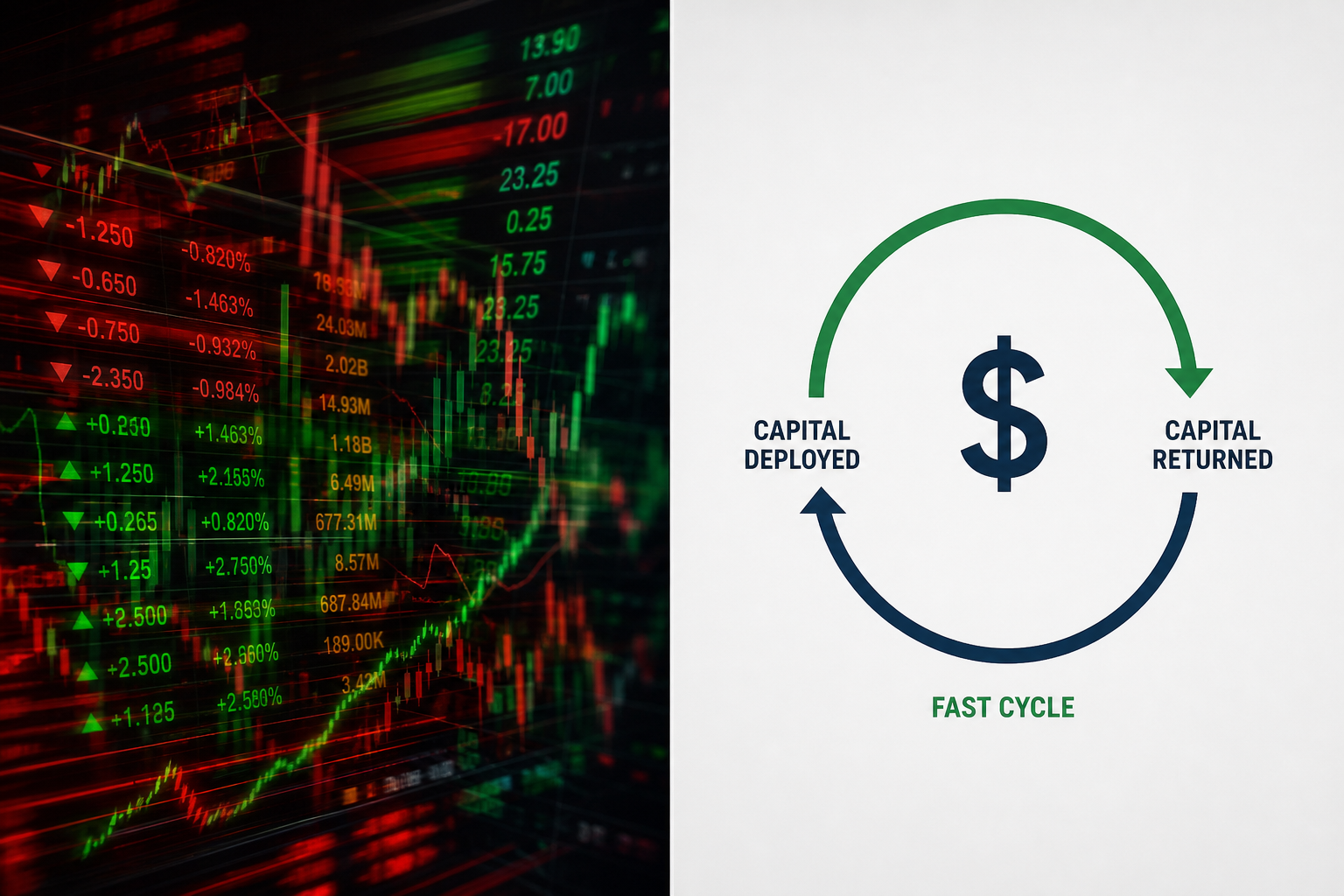
If you've ever felt disconnected from your own investment portfolio, you might be interested in a different way of thinking about returns: the velocity of capital. It’s a concept that focuses less on waiting for long-term appreciation and more on how quickly and frequently you can put your money to work.
What Is the Velocity of Capital?
In simple terms, capital velocity is a measure of how many times a single dollar can be invested, returned, and re-invested over a specific period. It’s about the speed and frequency of the transaction cycle.
Think of it like this:
- Low Velocity: You buy a rental property. Your capital is tied up in that one asset for years. You collect rent, but the bulk of your initial investment isn't available to you until you sell, which could be decades later.
- High Velocity: You run a bakery. You spend $100 on flour and ingredients in the morning. By evening, you’ve sold all your bread for $300. You have your original $100 back, plus $200 in profit, ready to be used again the very next day. Your capital is moving fast.
While traditional stock and bond investing often follows a low-velocity, “buy-and-hold” model, some alternative investments are built for speed. One such area is the Merchant Cash Advance (MCA).
An Introduction to Merchant Cash Advance (MCA) Assets
A Merchant Cash Advance isn't a loan. It’s a commercial transaction where a financing company purchases a portion of a business’s future revenue at a discount. In return, the business gets a lump sum of cash upfront.
Here’s the process:
- A small business needs working capital quickly.
- An MCA provider analyzes their sales data and provides them with, for example, $20,000 in cash.
- In exchange, the provider buys, say, $26,000 of the business’s future revenue.
- The business repays that $26,000 by automatically remitting a small, fixed percentage of its daily or weekly credit card sales until the amount is fulfilled.
For investors, it’s possible to participate in this market, often by investing in a fund that pools capital to provide these advances to a diverse group of small businesses.
How MCAs Put Capital Velocity into Practice
The structure of MCAs is what gives them their high capital velocity. Unlike a 30-year mortgage, the term for a typical MCA is much shorter, often ranging from 4 to 18 months [VERIFY].
Because the capital is returned daily or weekly through the business’s sales, the investor’s principal and profit are constantly flowing back. This allows the fund to redeploy that capital into new cash advances for other businesses. A single dollar from an investor could potentially be used to fund multiple different businesses within the same year.
This rapid cycle of deploying, returning, and redeploying is the essence of high-velocity investing. The goal is to generate returns not from a single, long-term bet, but from a high volume of short-term, sequential transactions.
Understanding the Risks and Trade-Offs
High capital velocity does not mean high returns are guaranteed. This strategy comes with a unique set of risks that are very different from the stock market.
- Default Risk: The primary risk is that the underlying merchant goes out of business. If their sales drop to zero, they can no longer make payments, and the investor's capital in that specific deal can be lost. This is a direct credit risk tied to the health of small businesses.
- Lack of Liquidity: This is not the stock market. You cannot sell your position with the click of a button. Your capital is committed for the duration of the advance or according to the terms of the fund you invest in.
- Due Diligence is Critical: The success of this strategy hinges entirely on the MCA provider's ability to underwrite effectively—that is, to pick healthy businesses that are likely to pay back the advance.
For business owners who are comfortable analyzing business credit risk and are looking for investments that aren't directly tied to the daily whims of Wall Street, this model can be appealing. The risks are more akin to the commercial credit decisions they make every day than to abstract market fluctuations.
Ultimately, focusing on the velocity of capital is just one of many strategies. For some, it offers a compelling alternative or a diversifying component to a portfolio dominated by traditional stocks and bonds. It prioritizes the active and repeated use of capital, a concept that many business owners intuitively understand and practice in their own ventures.
Disclaimer: This article is for informational and educational purposes only and should not be considered investment, legal, or tax advice. Investing in alternative assets like Merchant Cash Advances involves significant risk, including the potential loss of principal. You should consult with a qualified financial professional to determine if such investments are suitable for your individual situation.
