
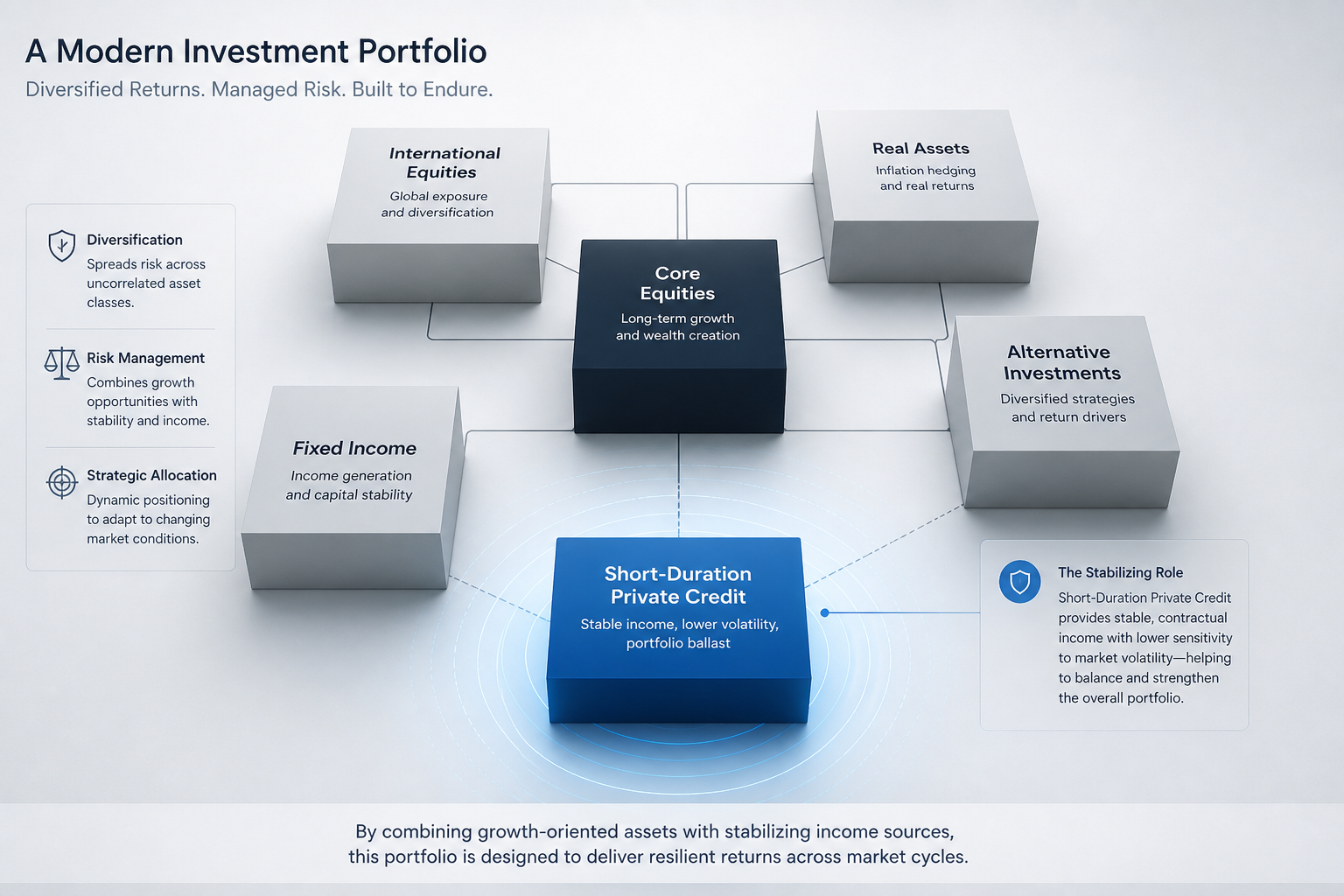
The Purpose of a Portfolio Is Resilience, Not Index-Beating
I have spent three decades advising clients through every imaginable market environment. If there is one principle that has proven its value time and again, it is this: the purpose of a portfolio is not to beat an index. The purpose of a portfolio is to preserve and grow wealth through all market conditions. This distinction is critical, and it forces a more rigorous approach to diversification—one that looks beyond the simple 60/40 model and questions the true correlations within our allocations.
In the search for non-correlated returns, many advisors have correctly turned to private credit. However, not all private credit is created equal. The long lock-ups, J-curve effects, and underlying ties to broad economic cycles in many direct lending or special situation funds can often mean we are simply swapping public market volatility for illiquid, private market volatility. To truly improve portfolio resilience, we must look deeper, to asset classes whose returns are generated by fundamentally different economic drivers.
Evaluating Private Credit Through a Correlation Lens
When my firm evaluates a private credit strategy, we don't lead with yield. We lead with correlation. A high-yield strategy that collapses alongside the high-yield bond market during a downturn offers no real diversification benefit. It is merely leveraged risk in a different wrapper.
This is where an allocation to merchant receivables, often executed through a Merchant Cash Advance (MCA) strategy, warrants serious consideration. This asset class involves purchasing a portion of a business's future receivables at a discount. The return is not generated by an interest rate coupon or the value of a company's stock, but by the daily, top-line operating revenue of a diversified pool of small and medium-sized businesses.
The key distinctions are structural:
- Return Driver: The return is tied to consumer and business spending at the granular level, which has a demonstrably low correlation to public equity and fixed-income markets. While a severe recession will impact business revenues, the performance is not directly linked to Fed policy announcements or stock market sentiment.
- Diversification: A well-managed fund provides exposure to thousands of underlying merchants across varied industries and geographies. This granular diversification is difficult to achieve in traditional corporate credit, which is often concentrated in larger, well-known issuers.
The Strategic Advantage of Short Duration
Beyond the low correlation, the most compelling structural attribute of merchant receivables is their exceptionally short duration. The typical receivable is collected over a period of 6 to 12 months. Compare this to the 5- to 10-year lock-ups common in private equity and many private credit funds.
This rapid capital turnover provides several key advantages for portfolio construction:
- Reduced Interest Rate Risk: In a changing rate environment, capital is not locked into long-term loans. As receivables are collected, capital can be redeployed at prevailing rates, providing a natural hedge against rising rates that punish long-duration bond portfolios.
- Mitigated J-Curve: New capital can be put to work almost immediately, generating returns far more quickly than in a typical draw-down fund structure that may take years to fully invest and begin producing cash flow.
- Enhanced Liquidity Profile: While still an illiquid asset, the consistent cash flow from maturing receivables provides a degree of systematic liquidity that is absent from longer-term strategies. This can be critical for managing portfolio-level cash needs without being forced to sell other assets at inopportune times.
A Fiduciary's Conclusion
Integrating an allocation to merchant receivables is not about chasing the highest possible yield in private markets. It is a deliberate, architectural decision to build a more robust portfolio. It is about adding a sleeve of assets that behaves differently because its returns are powered by a different engine—the day-to-day revenue of the real economy.
For the advisor or allocator whose primary duty is the preservation of capital, the dual benefits of low correlation and short duration should be the starting point of the conversation. In a world of financial assets that increasingly move in lockstep, finding a strategy that offers a structurally distinct return stream is the very definition of sophisticated diversification.
Disclaimer: This material is for informational purposes only and is not intended as investment, tax, or legal advice. Investing in private markets involves significant risks, including the potential loss of principal. Past performance is not indicative of future results. All investors should consult with their own financial and legal advisors before making any investment decisions.
