
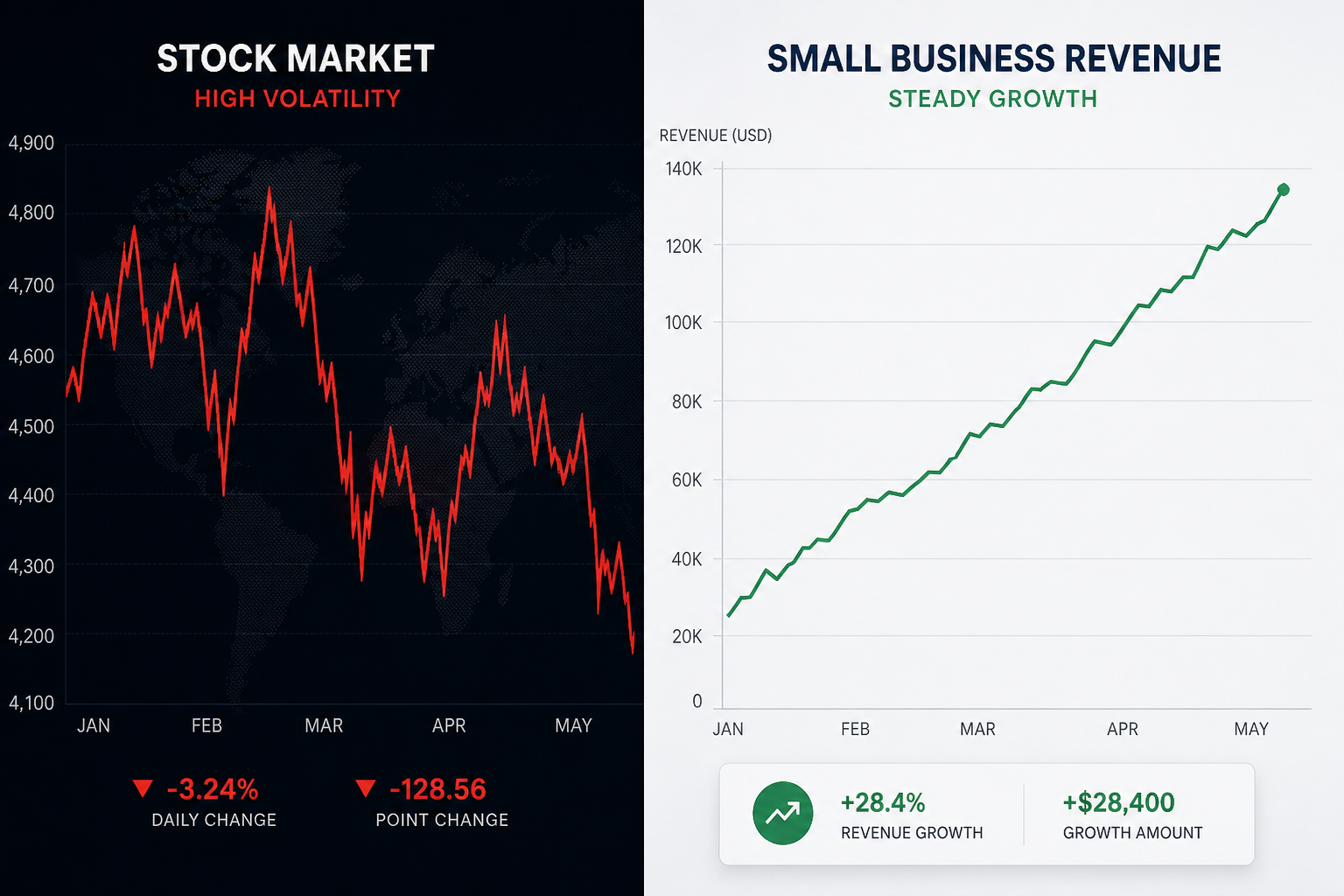
The Diversification Mirage in Public Markets
For decades, the foundation of portfolio construction has rested on a simple premise: a balanced allocation between equities and fixed income provides a durable hedge. When stocks fall, high-quality bonds are expected to rise, smoothing returns and protecting capital. Yet, in recent market cycles, we have seen this relationship falter. During periods of systemic stress, correlations across nearly all public asset classes have a tendency to converge toward one.
The reason is simple. These assets, from U.S. large-cap stocks to investment-grade corporate bonds, are ultimately priced by the same pool of institutional capital, reacting to the same macroeconomic inputs: central bank policy, inflation data, and broad economic growth forecasts. They are all swimming in the same water. True diversification, therefore, is not found by simply adding more securities from the same ecosystem. It is found by sourcing returns generated by fundamentally different economic drivers.
The Real Hedge: A Different Economic Engine
The purpose of a portfolio is not to beat an index. The purpose is to preserve and grow wealth through all market environments. To achieve this, I ask a different set of questions when evaluating a potential allocation. I don’t begin with the potential yield; I begin with the source of that yield. I don’t ask how it has performed relative to the S&P 500; I ask how it performs because of factors unrelated to the S&P 500.
An asset class that derives its return from a distinct economic engine offers a powerful diversifying effect. Its performance is not primarily dependent on investor sentiment or Federal Reserve commentary. Instead, its value is tied to a different, more insulated set of real-world activities. This is the core appeal of certain private credit strategies, and it is exemplified with particular clarity in the merchant receivables space.
A Case Study: Merchant Receivables
Merchant receivables, often categorized under the broader umbrella of merchant cash advances, are not loans. They are the purchase of a portion of a business’s future revenue—specifically, its credit and debit card sales—at a discount. An investor provides capital to a small business today in exchange for a percentage of its daily card sales until a specified amount is collected.
Consider the economic driver here. The return is generated directly by the daily operating revenue of a business. It is a function of customers buying goods and services from a restaurant, an auto repair shop, or a local retailer. This is Main Street commerce, not Wall Street speculation.
The correlation to public markets is structurally low for several reasons:
- Source of Cash Flow: The repayment stream comes from consumer transactions, an economic activity that is far more stable and less volatile than daily security prices. A market sell-off does not stop people from buying coffee or getting their car serviced.
- Short Duration: These are short-term assets, typically with durations of less than a year. This characteristic makes them relatively insensitive to the interest rate risk that can devastate long-duration bond portfolios.
- Idiosyncratic Risk: The primary risk is the operational failure of the underlying merchant. This risk is specific to that business, its management, and its market. It is not systemic risk tied to the broader equity market. Effective underwriting and diversification across hundreds or thousands of individual merchants is the key to managing this risk.
Structuring a Resilient Portfolio
Of course, no asset is without risk. A severe and prolonged recession would undoubtedly impact consumer spending and, by extension, merchant revenues. Diligence is paramount, and this is an asset class that requires specialized underwriting and management. It is not a passive investment.
However, for the sophisticated allocator, the inclusion of an asset class like merchant receivables within a private credit sleeve is a strategic decision. It is an explicit choice to incorporate a different economic driver into the portfolio. The returns are not generated by capital appreciation or coupon payments, but by the tangible, daily transactions that power our economy.
When I evaluate any investment, I am looking for resilience. I need assets that behave differently precisely when public markets are behaving badly. The search for that resilience should lead every serious investor beyond the familiar world of stocks and bonds and toward assets whose value is tied to a truly different engine of growth.
Disclaimer: This article is for informational purposes only and should not be considered as investment, tax, or legal advice. The information provided is general in nature and does not take into account your personal circumstances. All investments involve risk, including the possible loss of principal. Private credit and merchant receivables are complex, illiquid investments suitable only for sophisticated investors.
