
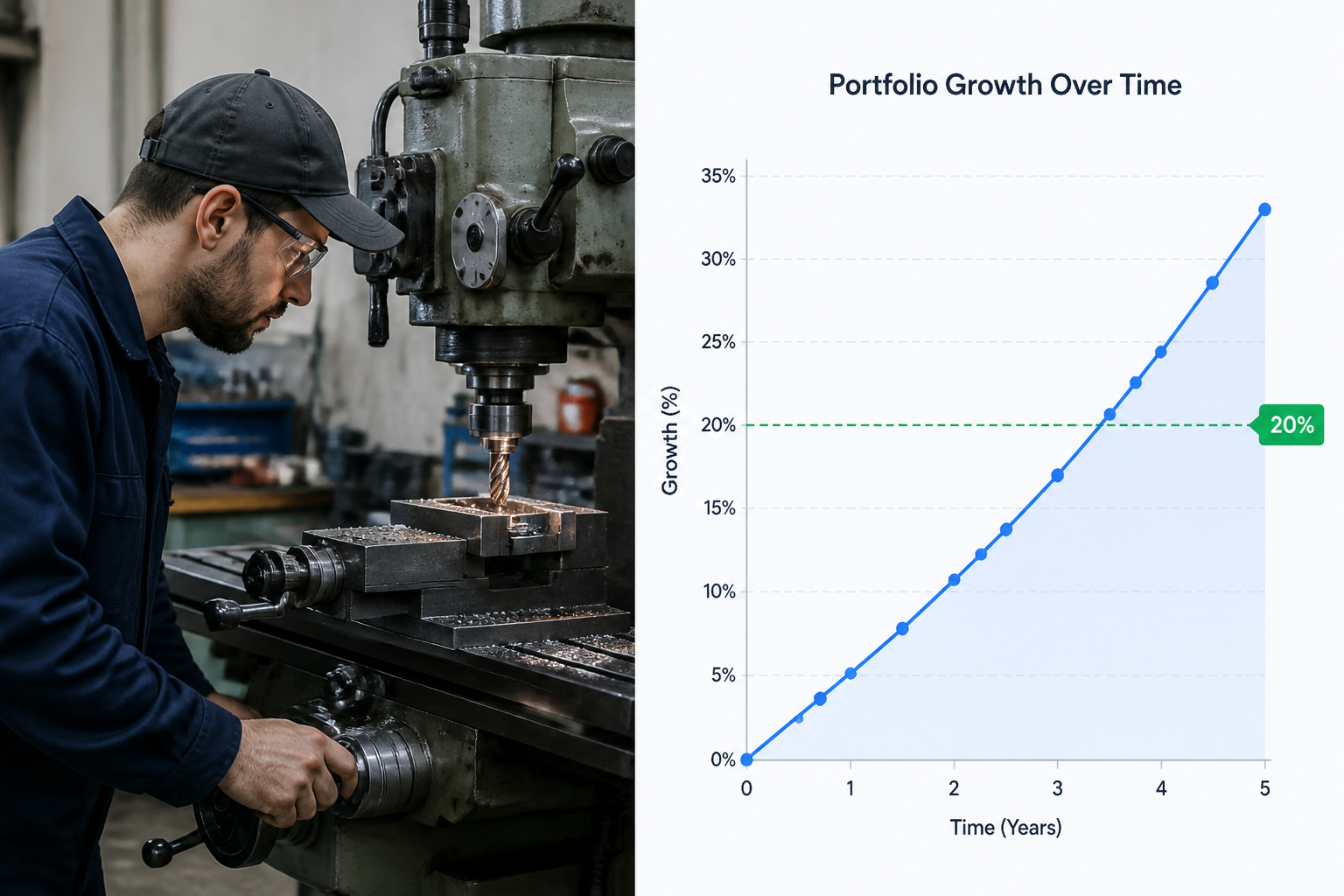
The Hardest-Earned 20% You’ll Ever Make
Ask any small business owner what a consistent 20% net profit margin would mean for their company, and you’ll likely see their eyes light up. A 20% return on equity is the stuff of dreams. It means you’re crushing it. It signifies a healthy, efficient, and highly successful operation that’s worth all the sleepless nights, inventory management headaches, and payroll stress.
Now, shift your focus to the world of investing. In online forums and social media, a 20% annual return from a stock portfolio is often seen as... just okay. New investors, caught up in the hype of meme stocks and crypto, often chase triple-digit gains, feeling disappointed by anything less. This is a profound and dangerous disconnect.
The secret to becoming a more grounded, patient, and successful investor might just lie in applying the hard-won lessons from your business. It’s called the 20% Business Mindset, and it’s about matching your investment expectations to your operational reality.
The Grind Behind the Gain
In a business, a 20% return doesn’t just appear. It is earned through a combination of:
- Capital Investment: You have to buy the equipment, lease the space, and purchase the inventory.
- Labor and Expertise: You and your employees have to show up, do the work, manage the clients, and solve problems every single day.
- Risk Management: You navigate supply chain issues, market downturns, changing customer tastes, and competitive threats.
- Operational Efficiency: You constantly look for ways to trim costs, improve processes, and maximize revenue from every dollar spent.
That 20% is what’s left over after all that effort and risk. It’s a tangible result of real-world work. When you're the one signing the checks and managing the team, you have a deep, intuitive respect for how difficult it is to generate that kind of surplus.
The Abstraction of the Stock Market
When you buy a stock, you are buying a fractional ownership stake in a real, operating business that faces all the same challenges. Yet, because we interact with it through a ticker symbol on a screen, that reality becomes abstracted. The process is so frictionless that it’s easy to forget the underlying company has to actually earn the profits that eventually drive your returns.
This abstraction leads to unrealistic expectations. An investor might expect a 50% return in a year from a company whose actual revenue is only growing at 10%. While stock prices can disconnect from fundamentals in the short term due to market sentiment, over the long run, a company’s value is anchored to its ability to generate cash and grow its earnings.
The historical average annual return of a broad market index like the S&P 500 has been around 10% before inflation [VERIFY]. Someone with a business mindset sees that number and thinks, “A 10% return for doing nothing but clicking a 'buy' button? That’s an incredible deal!” Someone without that context might see it as boring.
How to Invest Like a Business Owner
Adopting the 20% Business Mindset can fundamentally change how you approach your portfolio for the better. It’s not about limiting your potential gains, but about grounding your strategy in reality.
1. Analyze Your “Return on Effort”
A business owner instinctively understands trade-offs. Is it better to spend 40 hours a week actively trading for a volatile 25% return, or five minutes a year managing a passive index fund for a 10% return? For most people, the return on effort from the passive approach is infinitely higher. Your time has value; don’t discount it.
2. Perform Real Due Diligence
You wouldn’t merge with another company without scrutinizing their financials, leadership, and market position. Treat buying a stock with the same seriousness. Go beyond the ticker symbol and ask basic questions: What does this company actually sell? Who are its customers? What are its biggest risks? How does it make money?
3. Respect Your “Net Margin”
In business, revenue is vanity and profit is sanity. The same is true for investing. Your headline return isn’t what you keep. You need to subtract fees, taxes, and—most importantly—inflation to find your real, or “net,” return. A business owner is conditioned to focus on the bottom line, and so should an investor.
4. See Compounding as Reinvested Earnings
When a healthy business has a profitable year, the owner decides whether to take the profits as a distribution or reinvest them to grow the company. Reinvesting dividends and capital gains in your portfolio is the exact same concept. It’s the engine that allows your “portfolio business” to grow exponentially over time, and it requires patience, not frantic activity.
Your Unfair Advantage
If you’ve ever managed a budget, hired an employee, or sold a product, you have an intuitive understanding of the economy that many purely academic investors lack. You know how hard it is to build something of value.
Don’t discard that wisdom when you log into your brokerage account. A 20% return is a phenomenal achievement, whether it comes from your business or your portfolio. By treating your investments with the same respect and realism you apply to your company, you build a foundation for patient, sustainable wealth.
This article is for educational purposes only and should not be considered investment, legal, or tax advice. All investment strategies involve risk, including the possible loss of principal. Consult with a qualified financial professional before making any major financial decisions.
